Introduction
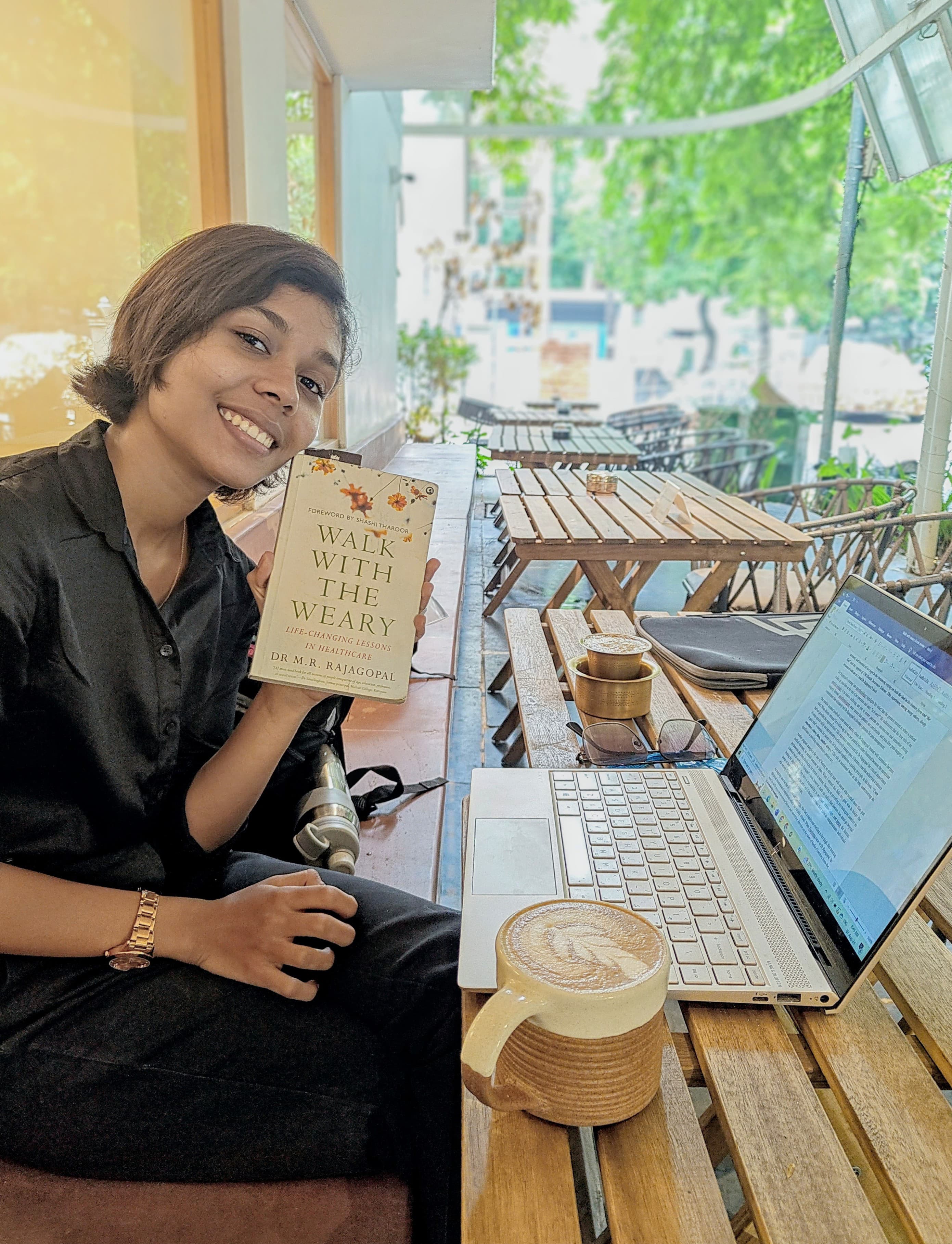
I’ve finally managed to overcome my writer’s slump and procrastination and completed the reviews for one of my reads this year. One of my favourite books of the year is Walk with the Weary: Life-Changing Lessons in Healthcare by Dr M. R. Rajagopal. This book is a must-read for anyone in healthcare and allied fields.
Personal Connection to Palliative Care
It holds a special place in my heart because palliative care has been a cornerstone of my commitment to this profession. As Dr Rajagopal mentions in Chapter 25, not every palliative care worker is as fortunate, with many succumbing to family pressures and opting for conventional careers. At one point, I too doubted my fit for this field due to lack of familial support and proper mentorship. However, Dr Rajagopal’s insights have been a significant source of motivation for me, as reflected in his words about the profound satisfaction derived from making a difference in people’s lives. Although I am still learning to cope with the bereavement of patients and the challenges faced by their families, I remain committed to bringing comfort and a smile to those in distress.
Relevance to Allied Healthcare Workers
Even though the book primarily addresses palliative care from a medical perspective, I, as an allied healthcare worker (medical social worker and transplant coordinator), found a deep connection with the experiences shared, interpreting them through my own lens. Chapter 25 resonated with me personally, as Dr Rajagopal had previously advised me on handling doubts about my ability to endure the emotional challenges of this field when I met him few months back during a workshop conducted by Golden Butterflies. In his book, he emphasizes the importance of creating a supportive community within the palliative care team, especially for introverts who may face burnout or depression. His advice to share struggles and seek support rather than battling them alone has guided me in managing my own feelings of burnout and anxiety.
Writing Style and Storytelling
As a beginner writer myself, I was captivated by Dr Rajagopal’s writing style in this genre. He begins the book with a poignant childhood memory involving his grandfather, who endures pain in silence until his grandmother comes to his aid. This anecdote underscores a crucial lesson: it’s okay to ask for help, a fundamental principle in pain and palliative care.
Ashla Rani, who was once a volunteer and is now a trustee at Pallium India, serves as a continual source of inspiration. Having lived with quadriplegia for over four years, she emphasizes that receiving care and support is a right, not a charity. Palliative care should be a universal right, accessible and available to everyone in need.
Dr Rajagopal’s commitment to Gandhian philosophy profoundly influenced his approach to palliative care. He embraced Gandhi’s belief in not turning away from necessary actions. Dr Rajagopal found purpose in pain management and palliative care, guided by Gandhi’s test of morality: whenever you are in doubt or when the self becomes too much with you, apply the following test: recall the face of the poorest and the weakest, who you may have seen and ask yourself if the step you contemplate is going to be use to them. Will they gain anything by it? Will it restore them to a control over their own life and destiny?
Historical Context of Pain Management
In the mid-1960s, Dr Rajagopal recounts a harrowing experience involving his cousin, who suffered from a rare cancer of the sweat glands and tumors on his scalp. The pain was excruciating, and when the family requested pain relief, the physician responded with skepticism, questioning how cancer could ever be pain-free. At that time, the concept of alleviating cancer-related pain was virtually unheard of. It wasn’t until 1967 that the first modern hospice center was established in London by a British nurse and physician. This pioneer introduced the medical community to the idea of pain management and the belief that dying individuals deserved dignity, compassion, and respect.
Personal Experience in Patient Care
Just as the British nurse-turned-physician championed the idea that dying individuals deserve dignity, compassion, and respect, I’ve always been guided by the belief that patients should be treated with dignity regardless of their background or the severity of their illness. This principle was reinforced by the physician I work with, whose approach to patient care inspired me to continue in this field. Despite my initial stereotypes and trust issues with the medical system, particularly in government sectors in India, my experience with this physician has proven those doubts wrong. She prioritizes patients, focusing not just on treating diseases but also on maintaining their dignity throughout their battle with life-threatening conditions. One memorable case was Baby T, a 5-month-old with SCID and Omenn Syndrome, who was brought to us at RGGGH for treatment. The situation was medically complex, but my physician’s commitment was unwavering: regardless of the outcome, our aim was to provide both the child and the mother with a comfort care and would be treated with the utmost dignity. The mother, already frail and financially strained, had invested all her hope in the treatment, relying on both the God in the human form and ‘the God’ and the support of CM Health Insurance Scheme. This experience, among many others, deeply resonated with me as I read Dr Rajagopal’s book. Dr Rajagopal’s journey into anesthesiology highlights his belief that the greatest reward is when a patient wakes up pain-free at the end of an operation and asks, “Is it over?” He underscores that the true role of an anesthesiologist is to relieve suffering, not just to ensure patients are unconscious and immobile during surgery. Instead, anesthesiologists must ensure that patients are comfortable and pain-free post-surgery, a commitment that ultimately led Dr Rajagopal to develop a passion for pain management.
Importance of Proper Pain Management
One notable incident involved a cook named Morris, whom Dr Rajagopal treated with morphine for pain relief. When Morris returned for a follow-up, he was not grateful but rather frustrated because the morphine had not provided the expected relief. This experience underscored for Dr Rajagopal the critical importance of using opioids safely and appropriately to effectively manage pain. It became clear that achieving a balance in pain relief is essential for patient care. Dr Rajagopal emphasizes a guiding principle in his book: “Cure sometimes, relieve often, comfort always.” This rule is mentioned twice in the text, underscoring its significance in providing comprehensive patient care.
Another example is the case of Warrier, an elderly man with cancer who needed more than just medical treatment, he needed someone to listen. When I entered this field, my goal was to bridge the psychosocial gap often challenging for doctors to address, focusing on providing psychological comfort as a medical social worker. Dr Rajagopal’s book, however, made me realize that doctors, too, must go beyond treating the physical body. They have a responsibility to recognize, acknowledge, and honor the human aspect of their patients. This can be achieved if doctors embrace their roles as compassionate individuals who actively listen and engage with patients.
The Power of Compassionate Listening
An inspiring case was that of 11-year-old Thasleena, who had a significant swelling in her thigh. Her treating physician recommended amputation, which she initially refused. When Thasleena came to Dr Rajagopal, he used his skills as a compassionate listener and storyteller, drawing on the story of Sudha Chandran from the movie Mayuri, who achieved success as a leg amputee. Although Thasleena ultimately had metastatic cancer in her lungs, she displayed remarkable hope and resilience in the time she had left, exemplifying the true power of palliative care.
The incident involving Shambu underscores the critical need for recognizing and addressing pain in the medical field. Shambu was in dire need of surgery, but neither the treating physician nor the family could obtain his consent until Dr Rajagopal’s pain and palliative care team intervened. By first addressing Shambu’s pain, Dr Rajagopal highlighted that pain is not merely suffering, it clouds the mind, making rational thought difficult and consuming every part of a person’s mental and physical space. Once Shambu’s pain was managed, he was able to think clearly and consent to the surgery. Dr Rajagopal also notes that long-term pain, such as chronic back pain, can cause irrevocable changes in a person, leading them to maintain a façade of normalcy in public while crumbling in private. The case of Sunshine highlights another important aspect of pain management and palliative care. Sometimes, when individuals describe their pain, they are dismissed as having merely a psychological issue. Sunshine’s pain was ignored, and she was directed only toward behavioral therapy. Dr Rajagopal notes that this issue is not unique to India; even in the US, people in pain can be dismissed as psychiatric cases, leaving them with limited treatment options. I recently witnessed this myself when a friend was told by several physicians she was referred to, “Get your mind strong” rather than receive appropriate pain management for her chronic condition. Having lived with chronic pain for over eight years, she is now afraid to admit her suffering for fear of being perceived as unstable, especially given her career in healthcare. Reading Dr Rajagopal’s insights on this issue felt like a comforting embrace, and I’m considering sharing his book with my friend to offer her some solace.
The Role of Palliative Care
As Dr Rajagopal mentions in his book: “Palliative care provides a valuable alternative to aggressive life-support measures for those with advanced, incurable illnesses. By administering the right medications for comfort and offering a touch of compassion, palliative care enables patients to smile, eat, and drink again, ultimately allowing them to experience a dignified and compassionate death”.
When people ask why I chose to work with individuals with terminal illnesses, or like I mentioned in my bio stating my interest to work with individuals with Parkinson’s disease or multiple sclerosis, I always give the same answer. In situations where life seems devoid of hope or where pain seems insurmountable, I want to be part of a team that offers a semblance of hope and alleviates pain. My goal is to provide comfort and see smiles on patients’ faces, and to ensure they have a dignified and compassionate death. For conditions like Parkinson’s and multiple sclerosis, which are chronic and degenerative, I aim to offer comfort and hope, focusing on rehabilitation to help patients achieve the best possible quality of life, a near-to-normal life experience. No one should be neglected simply because their condition is chronic or seems hopeless. I want to be that person who provides comfort care and dignified healthcare during their most challenging times.
Impact of the Book
Through stories of love, faith, hope, and grief, set against the backdrop of illness, Dr Rajagopal shares insights from his own life through a compilation of his experiences with people suffering from life-limiting illnesses, which is a great source of lessons on living and dying well. This book is a must-read for anyone in healthcare, offering a perspective that could change your approach to patient care. Many chapters moved me to tears, making me feel as though I was standing beside Dr Rajagopal and his palliative care team, reliving his experiences and understanding their pain. I have gained valuable insights from this book.
Current State of Palliative Care in India
In India, pain and palliative care still face significant challenges. A recent study by Dr Sharma, published in the New India Express on June 30, reveals that 98 out of every 100 patients with stage-4 cancer do not receive palliative care, despite the national program launched in 2012. Kerala is currently the only state with a successfully implemented palliative care program, covering care from primary to tertiary health facilities. Dr Sharma’s study also emphasizes that a peaceful and dignified life and death is a fundamental right, and it is the government’s duty to ensure no one suffers needlessly at any stage of life, including at the end.
Gratitude and Closing Thoughts
Dr Rajagopal’s book also fuels my long-term goal of expanding palliative care, especially in Tamil Nadu. His journey in establishing the Pain and Palliative Care Society is deeply inspiring. I hope to contribute to this cause in the future with more learning and experiences that comes along my path and with the community support and by assembling the best possible resources and team in the future who will share my vision.
Thank you, Dr Rajagopal, for your motivating and reassuring words that day, which helped me regain confidence and remain in the field and helped me to work on myself with my burnout being a fresher into the field. I also appreciate you sharing your extensive experience through this book, which will undoubtedly help many people understand the significance of pain and palliative care and the support we can offer.