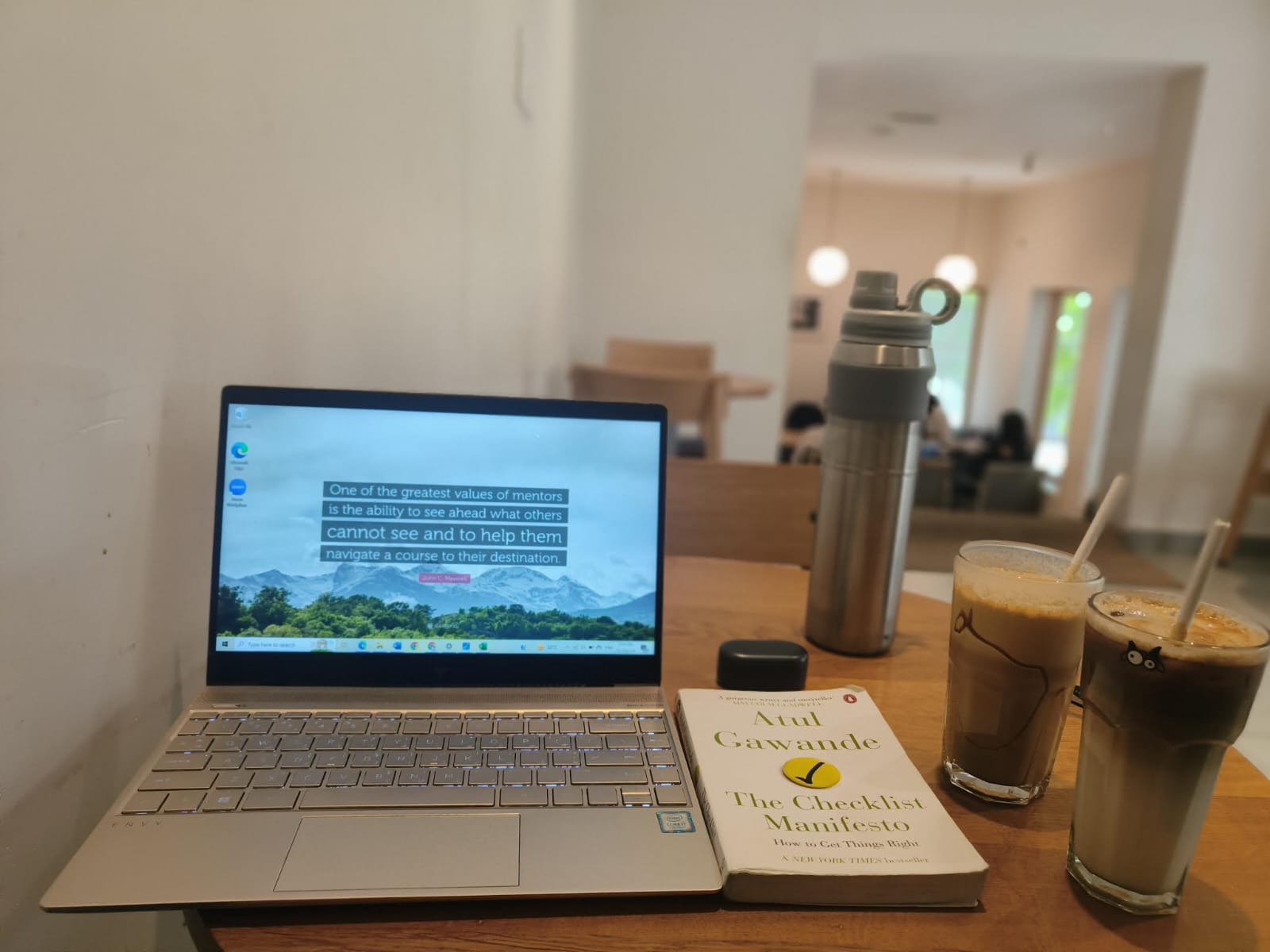
Back again with a book review!
This is one of the books I started last year, however finished during the beginning of this year. One of the reviews I’ve been procrastinating on, but it’s time to share it now. This book was actually referred to me by my mentor long back when I was working with her. Back then, I was a bit lost, maybe unsure about things, and she probably saw the importance of this book for me. Well, it turns out, she was right…it’s important for everyone! It’s been a game-changer for me.
With everything going on in my life right now…juggling work and personal life, still adjusting to a new city and place, taking on added roles and responsibilities as they come, and learning ahead, it sometimes feels like a lot. I’ve started tackling tasks with a checklist, and trust me, it works great! It made me realize how effective checklists can be in larger setups, especially as I focus on my long-term goal of palliative care.
In his book, The Checklist Manifesto, Dr Atul Gawande doesn’t just talk about staying organized, but it’s about making systems work better, preventing mistakes, and how even the smallest steps can have huge consequences.
As someone working in health communication with an eye on palliative care, this book really resonated with me.
Personal learning
On a personal level, I’ve learned that something as simple as a checklist can bring clarity to overwhelming situations. Life can get chaotic, and having a way to focus on the essentials really helps me stay grounded. It’s not just about ticking off tasks, it’s about simplifying complexity and reducing mistakes….something I can now apply both at work and in my personal life.
Recently, when I faced a bit of confusion regarding a career-related decision, I created a practical checklist to help break down the options. It helped me when I hit a dead end and couldn’t decide on my next step, it was as important as that. It gave me structure, clarity, and confidence in my choice. What’s even more interesting is that this concept of simplification is applicable not just in our day-to-day tasks but in solving big, complex issues that we often face in both personal and professional life, and just imagine how much of a difference it could make in a healthcare setting.
Professional learning
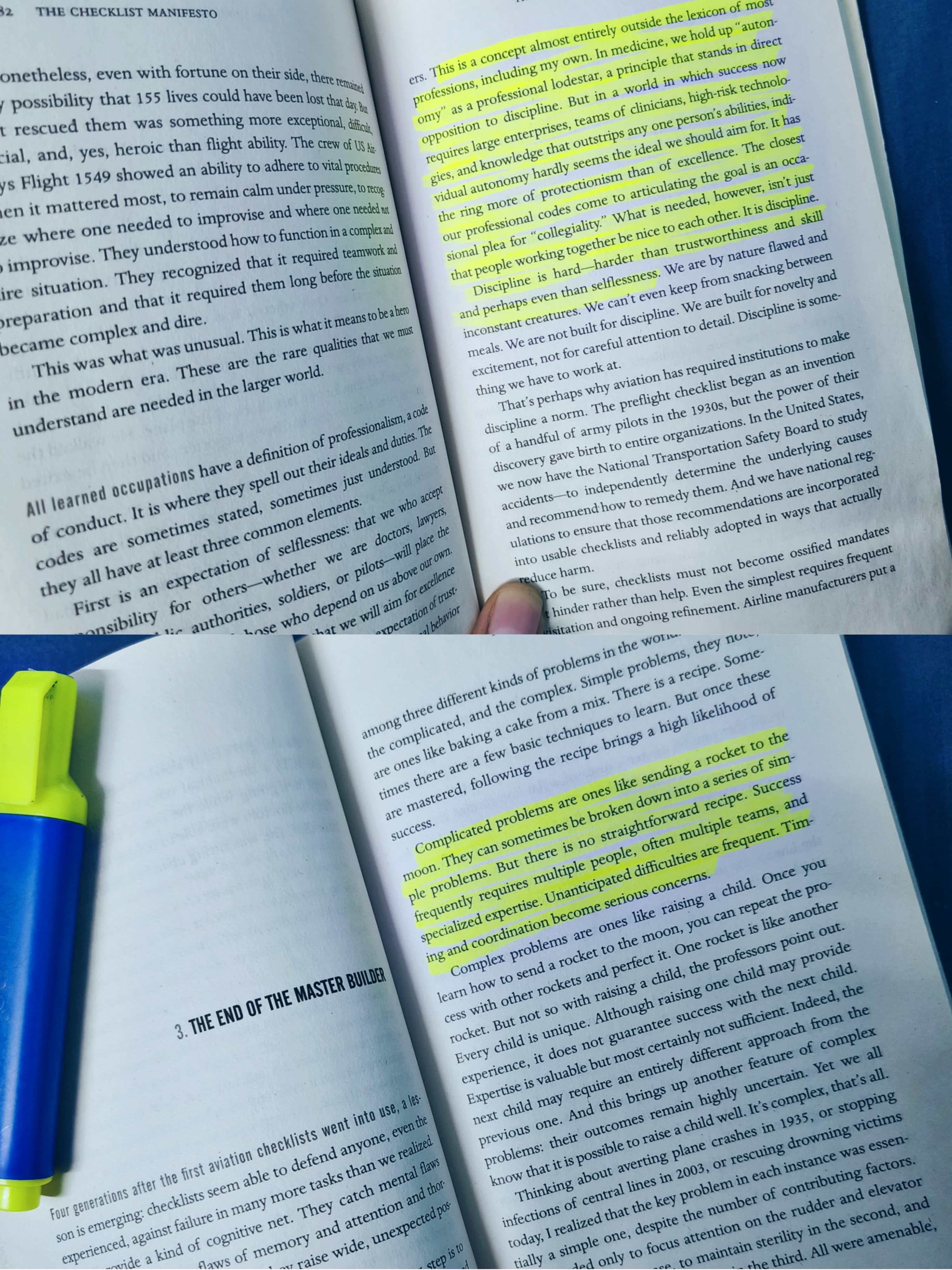
From a professional view, I’ve come to see checklists as an essential tool for improving outcomes, particularly in healthcare. Dr Gawande takes us into operating rooms, airplane cockpits, etc., to show how checklists manage complexity. In one of his initial, and most effective examples, at John Hopkins hospitals, a simple five-step checklist for inserting central lines led to infection rates dropping from 11% to 0%. It’s not about fancy technology, it’s about following the steps.

It’s clear that the more complex a task becomes, the more necessary it is to have a system in place to track and ensure that all steps are being followed properly. Pilots use checklists before every flight. Doctors use them in surgeries. The more complex the task, the more important it is to have clarity.
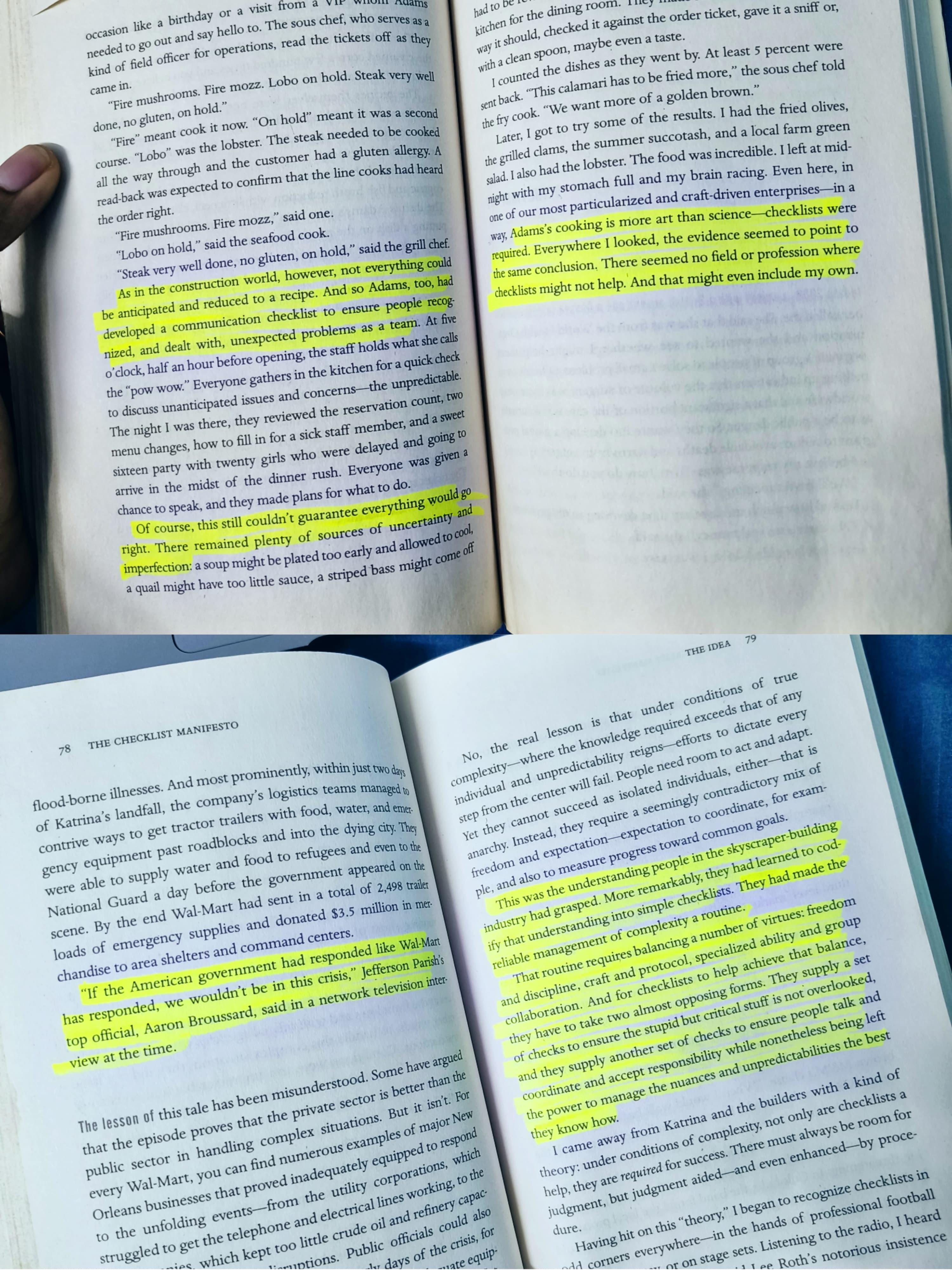
One other most important scenario from the book is about Walmart. They used checklists to deal with the aftermath of Hurricane Katrina. When the disaster struck, the company faced the monumental challenge of delivering supplies and rebuilding its operations. What stood out was how their pre-existing checklist system allowed Walmart to respond quickly and efficiently. Despite the chaos, the company was able to deploy its employees and resources in a streamlined way, using a system that made the entire recovery process much more efficient.
Another memorable example is of Adam, a chef. In their kitchen, Adam developed detailed checklists for every dish, checklist for the customers, ot because he lacked skill, but because he understood that consistency and excellence come from preparation and systems. Each item, from ingredients to plating was double-checked by the team. This wasn’t about micromanaging talent; it was about respecting the complexity of the craft. Just like in a kitchen, where every step, from ingredients to plating, and customer preference is double-checked, palliative care requires a checklist at every turn. Whether it’s managing pain, providing comfort, or communicating with the family, every detail must be checked to ensure no aspect of the patient’s care is overlooked, preserving dignity and quality at each stage.
Checklists aren’t just about listing tasks…they’re about creating systems that allow for smooth execution, minimizing human error, and focusing on what truly matters. In healthcare, especially in palliative care, where there’s often a lot of emotional and physical complexity, checklists could play a crucial role in minimizing errors and improving patient care.
Healthcare could be more…human
Dr Gawande, despite being a top surgeon, openly talks about mistakes. He emphasizes human fallibility and the courage it takes to admit. He mentioned that he needs a checklist! We need more professionals like him…people who challenge the status quo and encourage teamwork.
It made me think…this is what palliative care teams should feel like. Different professionals working together, supported by systems like checklists to ensure nothing is missed, and everyone has a role to play. It’s about creating a culture where speaking up is encouraged, and the focus is always on the patient’s well-being, not just the tasks at hand.
Reading this reminded me of a turning point in my own thinking: Walk With the Weary by Dr M R Rajagopal. That book was my first heartfelt and real glimpse into the world of palliative care. It was a learning and unlearning moment, and opened my eyes wider to the idea that I firmly believe - that healthcare is not just about treating diseases.. it’s about being present, easing pain, and preserving dignity.
Dr Gawande’s book hit that same nerve, but from a different angle. He’s showing that in healthcare…and really, in any complex field, systems matter. Checklists help ensure the basics don’t get overlooked, and that leads to better outcomes for everyone involved. It’s about keeping things simple and human.
I’m now eyeing Compassionomics: The Revolutionary Scientific Evidence That Caring Makes a Difference by Stephen Trzeciak and Anthony Mazzarelli, and Dignity in Care by Harvey Max Chochinov. (Feel free to get me either one. I won’t stop you, lol :P)
If you work in healthcare, policy, or communication, or if you care about improving systems, please give this book a read. It’s a great, realistic, honest, and moving book that makes a case for why checklists aren’t about limiting creativity…they’re about ensuring what matters doesn’t get lost in the chaos. In healthcare, especially in palliative care, that clarity is everything is what I believe!